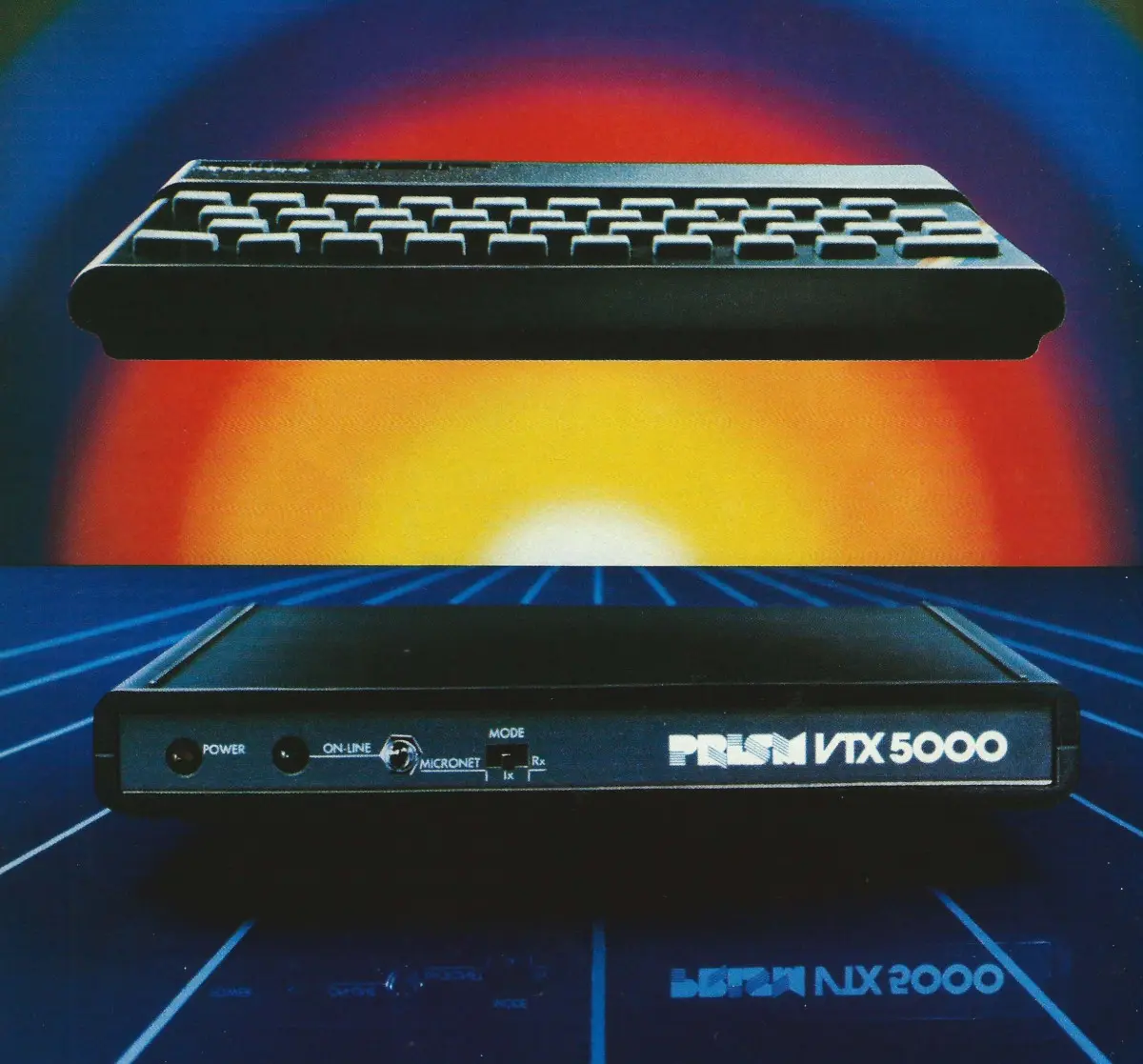
The Prism VTX5000 for the ZX Spectrum and the first modem I ever owned. With its bright colourful viewdata graphics and decent-download 1200/75 bps speed it ignited my life-long interest in data communications and online communities.
I've not announced it directly but I used Claude Code recently to create a web-based Speccy emulator called ZX84 emulator and thought it might be fun to implement VTX5000 support although it really is just a curiosity as there's nothing left to connect to but it involved going down quite an interesting rabbit hole that's worth documenting.
So here it is! Part 1 covers the background of this modem, part 2 will move on to the hardware and part 3 will include a fully annotated dissasembly.
Teletext
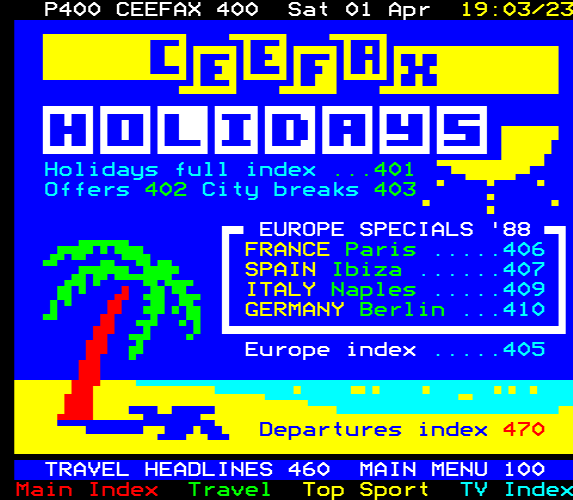
In 1974 the UK's BBC launched Ceefax ("See Facts") - a system that embedded pages of text and colourful blocky graphics into the unused hidden lines of the broadcast TV signal. ITV (channel 3) followed with Oracle and they both worked the same way -press a button on your remote, typed a three-digit page number, and wait while the carousel of pages cycled around to yours. Weather, news, football scores, TV listings and subtitles.
The chip that made it all work was the SAA5050 Teletext Character Generator produced by Mullard under license from Philips. It took 7-bit character codes and rendered them into a 24×40 character display with eight colours, flashing text, double-height characters and "mosaic graphics" - 2x3 grids of blocks packed into a single character giving you a canvas of chunky, colourful pixels. The whole teletext visual language - the blocky weather maps, the primitive logos, the garish colour schemes - was defined by what this character set could do with all sorts of odd limitations - no black foreground, each color change taking up a character space on the screen etc.
Prestel
A few years later the UK government was heavily pushing information technology. The BBC Computer Literacy Project gave us the BBC Micro - in conjunction with it's Micro Live TV program - but it was just one part of a broader push to get Britain wired - if Japan had robots and America had Silicon Valley then Britain needed at least a computer-literate workforce.
Part of that vision was interactive electronic information. Teletext was broadcast-only, one-way. The General Post Office - and soon afterwards as the newly formed British Telecom - imagined a two-way solution: Prestel.
Launched in 1979, Prestel was the world's first public Viewdata service. It featured the same visual language as teletext but was now delivered over phone lines and crucially interactive - you could navigate page trees with *page# commands, send messages, even do your banking. Prestel was however very much a corporate tool with little content aimed at home computer enthusiasts.
Bulletin board systems already existed at the time but they were purely text-only affairs with very specialist or hobbist crowds. They too would evolved over time but BBSs like my own Black Ice wouldn't see colourful ANSI screens until the mid 80s - long after Minitel unleashed its colourful take on things on the French population in 1982.
Prism and Micronet 800
Prism starts as a publisher of software for the ZX81 and went on to be the the retailk distributor of the ZX Spectrum getting it into the high street. Prism didn't last all that long but co-founder Bob Denton has chronicled many of his stories over at his blog. It's well worth a read for details of chance encounters with Sir Clive leading to a multi-million-pound distribution deal, hanging out with Atari's Nolan Bushnell in Paris, chaotic trips to China and a warehouse of Spectrum's being the target of an armed robbery.
The company was formed when Bob Denton met Richard Hease at a launch party at Mullard. Bob had his retail and distribution experience, Richard had been running publishing at EMAP including Sinclair User and Sinclair Programs, and they combined forces to develop the home-computer hub of Prestel's Viewdata service.
Named Micronet 800 after the page number of the existing computing section. It had computing news, reviews, messaging, downloadable software and multi-user games - an online social network for 1984 but tTheir intended audience needed an easy way to get online.
And so Prism branched out into producing modem solutions for the BBC Micro, IBM PC, Sirius, Apple II, ZX81, Sinclair QL and of course our faithful ZX Spectrum.
The Spectrum's problem
Some machines were clearly more suited for this connected future. The BBC Micro now only had it's own Econet networking and a RS-423 serial port but literally booted into viewdata mode - known as MODE 7 on the Beeb - thanks to the inclusion of that very same SAA5050 chip on the motherboard. Connecting to Prestel was going to be a breeze.
The Spectrum had nothing of the sort.
Sinclair, ruthlessly cost-reducing as ever, had given it a keyboard, a display, a cassette port and an expansion bus. No serial port, no teletext chip.
Given Prism's ties to Sinclair and the sheer number of Spectrums in people's homes (the Beeb won the battle for the classroom but the Spectrum owned the bedroom) they needed a solution and Sinclair's own Interface 1 had limited adoption, limited ability and would push the cost higher.
Enter the Prism VTX5000.
In part 2 we'll look at the hardware inside the box.
0 responses